
It is a broad change to Google’s core ranking systems, not a penalty or a targeted update. Google describes it as a regular update designed to “better surface relevant, satisfying content for searchers from all types of sites.”
That is the same wording Google used for the March 2026 core update. Google hasn’t named any specific focus, published a Search Central blog post or updated its core updates documentation, which was last revised in December 2025.
In practice, core updates reassess how well pages meet search intent. Some pages gain, some lose, and many don’t move at all. Google says it doesn’t target individual sites or pages.
How does it compare with earlier 2026 updates?
The November rollout arrives more than five months after the May core update finished. Three spam updates ran in between.
| Update | Dates | Duration |
|---|---|---|
| November 2026 core update | 10 Nov – in progress | Up to 2 weeks |
| September 2026 spam update | 24 Sep – 8 Oct | 13 days, 16 hours |
| August 2026 spam update | 18 Aug – 21 Aug | 2 days, 16 hours |
| June 2026 spam update | 24 Jun – 26 Jun | 2 days, 1 hour |
| May 2026 core update | 21 May – 2 Jun | 11 days, 21 hours |
| March 2026 core update | 27 Mar – 8 Apr | 12 days, 4 hours |
Both earlier core updates this year took around 12 days, so expect November’s to finish close to the two-week mark.
Who will be affected?
Every site can be affected, because core updates apply to all languages, countries and content types. The biggest swings usually hit sites where content is thin, outdated or written for search engines rather than people.
Watch these areas closely:
- eCommerce and retail — product and category pages competing on holiday-season terms.
- Affiliate and review sites — pages without first-hand testing or original insight.
- YMYL content — health, finance and legal pages, where expertise and trust weigh more.
- AI-assisted content at scale — pages that repeat what already ranks without adding value.
Why Black Friday complicates the data
If the rollout runs a full two weeks, it ends around 24 November. The following week includes US Thanksgiving (26 November), Black Friday (27 November) and Cyber Monday (30 November).
Retail sites comparing that week with a normal pre-update week will see seasonal demand mixed in with algorithm impact. UK retailers are affected too, as Black Friday traffic now peaks here in the same week.
Compare like with like: use the same week last year, or compare non-commercial pages that aren’t driven by seasonal demand.
What should you do during the rollout?
Do nothing drastic. Rankings often rise, fall and recover within the same rollout, so changes made now can’t be measured cleanly.
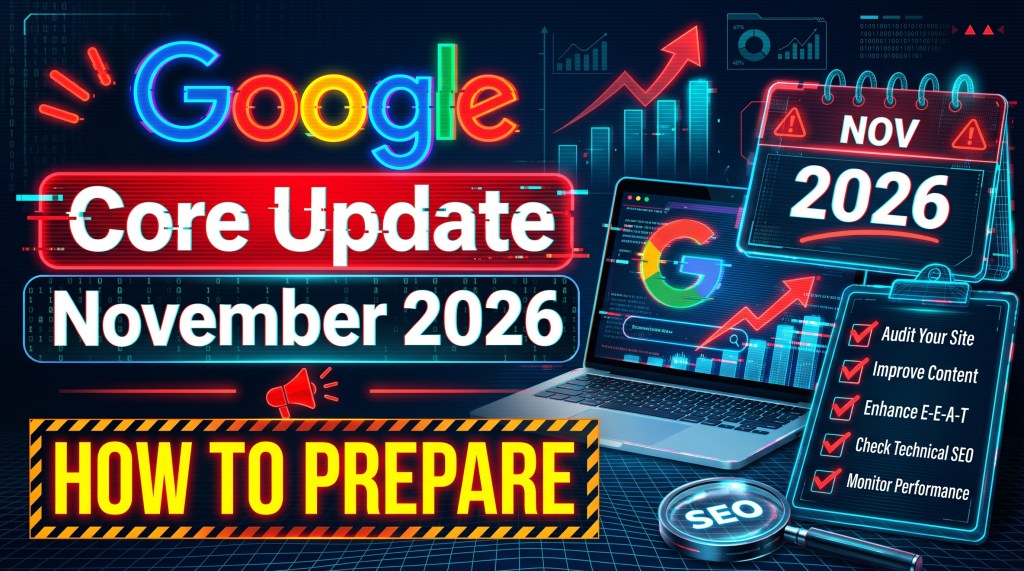
- Record your baseline now. Export Search Console performance data for 3–9 November 2026, the week before the rollout started.
- Annotate your analytics. Mark 10 November in GA4 and your rank tracker so future reports explain any shift.
- Monitor, don’t react. Track your top 20 pages and keywords daily, but hold off on content or technical changes.
- Keep publishing as planned. Normal content updates are fine; just avoid site-wide rewrites, migrations or URL changes.
How to measure the impact after the rollout
Google recommends waiting at least one full week after the rollout completes, then comparing that week with the week before it began.
- Wait for Google to confirm completion on the Search Status Dashboard.
- Leave one full week, then compare it with your 3–9 November baseline in Search Console.
- Filter by page and query to find exactly what moved; site-wide averages hide the detail.
- Separate ranking drops (lower average position) from demand drops (fewer impressions at the same position).
- Check whether competitors who gained are better at answering the query, not just better optimised.
How to recover if you lose rankings
There is no specific fix for a core update. Google rewards pages it judges more helpful, so improve the content itself.
- Audit the pages that dropped against the pages now outranking them. What do they answer that you don’t?
- Add first-hand experience — original photos, data, testing and named, credible authors.
- Update or merge thin and outdated pages instead of producing more of the same.
- Match search intent — if Google now ranks guides above product pages, give searchers what they want.
- Improve page experience — fast loading, clean layout and no intrusive pop-ups.
- Be patient — recovery often comes with the next core update, not overnight.
What it means for AI Overviews and answer engines
Core updates shape which pages Google trusts most, and those trusted pages are the ones most often cited in AI Overviews and AI Mode. Clear, well-structured answers with credible sources help on both fronts.
To strengthen AI visibility alongside rankings:
- Open each section with a direct, two-sentence answer.
- Use question-led subheadings that mirror how people search.
- Add structured data (Article, FAQPage, Product) so machines can read your content accurately.
- Keep facts, prices and dates current, and show when a page was last updated.
Frequently asked questions
When did the Google November 2026 core update start?
The update began rolling out on 10 November 2026 at 10:06 a.m. Pacific Time, according to Google’s Search Status Dashboard. Google expects it to take up to two weeks to complete.
How long does a Google core update take to roll out?
Most core updates take around two weeks. In 2026, the March update took just over 12 days and the May update took almost 12 days. November’s is expected to finish around 24 November.
Is the November 2026 core update a penalty?
No. A core update reassesses content quality and relevance across the whole web. A drop means Google now judges other pages as more helpful for that query, not that your site has broken a rule.
Should I change my website during a core update?
Avoid major changes until the rollout ends. Rankings often fluctuate before settling, so edits made mid-rollout make it impossible to tell what caused any later movement.
How do I know if the core update affected my site?
Wait one full week after Google confirms the rollout is complete. Then compare Search Console clicks, impressions and average position against the week before 10 November, filtering by page and query.
How do I recover from a Google core update?
Improve the pages that lost rankings by adding first-hand experience, updating outdated information and matching search intent more closely. Recovery often shows during the next core update rather than immediately.
The bottom line
The November 2026 core update is a routine but significant reshuffle, landing just before the busiest retail fortnight of the year. Record your baseline now, hold off on big changes, and judge the impact only once the rollout is complete.
We’ll update this post as soon as Google confirms the rollout has finished. Need a hand reviewing your rankings? Get in touch for a core update audit.

